Nature-Inspired Emission Control :How UV & Plasma Systems Transform Industrial Air Treatment
/in All Webinars, Recorded/by Bart MuijtjensNature-Inspired Emission Control :How UV & Plasma Systems Transform Industrial Air Treatment
Traditional emission control systems often rely on thermal technologies that can be effective, but energy-intensive, costly to operate, and not always the best fit for low to moderate VOC loads. In this recorded webinar, BM Process Management and Oxitec explore how nature-inspired non-thermal UV and plasma technologies can help industrial facilities reduce odour, VOC emissions, and harmful exhaust components more efficiently, while supporting electrification and lower operating costs.
Webinar Overview
Industrial plants today face growing pressure to reduce VOC emissions, odours, and harmful air pollutants while also improving energy efficiency and complying with stricter environmental regulations. Traditional thermal oxidation systems such as RTOs remain widely used, but they are not always the most economical or sustainable solution, especially for variable, low to moderate concentration exhaust streams.
In this webinar, Amol from BM Process introduces the practical challenges industries face in emission control, followed by insights from Bart and Frank, who explain how a process-first approach helps identify the right treatment strategy for each exhaust stream. The session highlights where UV and plasma-based non-thermal oxidation systems fit into the emission control landscape, how they compare with conventional thermal solutions, and where they can deliver the greatest value across sectors such as chemicals, food and feed, wastewater, recycling, pharmaceuticals, coatings, and manufacturing.
The speakers also discuss how system feasibility can be assessed before investment, how variable VOC loads affect technology selection, and how modular UV and plasma systems can improve flexibility, reduce energy use, and support compliance with modern industrial air treatment demands.
Who this webinar is for
- Process engineers and emission control specialists
- Plant managers and terminal operators
- Environmental, health and safety professionals
- VOC and odour control decision-makers
- Chemical, food, feed, recycling, and manufacturing professionals
- Anyone evaluating alternatives to thermal oxidation systems for industrial air treatment
Key Themes Covered
- Why industrial emission control projects increasingly require more than traditional thermal solutions
- The importance of understanding the exhaust stream before selecting a treatment technology
- Where UV and plasma air treatment systems are most effective in the industrial emission control landscape
- Differences between thermal oxidation, UV systems, plasma systems, and hybrid treatment combinations
- How non-thermal technologies can treat low to moderate VOC concentrations and odour-driven exhaust streams
- Key feasibility factors including VOC concentration, humidity, temperature, aerosols, and peak loads
- How modular system design supports operational flexibility and easier scaling
- Applications in industries such as pet food production, battery recycling, pharmaceutical coating, printing, wastewater, and process manufacturing
- How non-thermal technologies can reduce energy consumption, CO2 impact, and operating costs compared with traditional systems
- Practical considerations for pre-treatment, post-treatment, catalyst integration, and system cleaning
Key Takeaways
- Not every exhaust stream should default to an RTO or another thermal solution
- A process-first, technology-second approach leads to more reliable and cost-effective emission control decisions
- UV and plasma technologies are especially suitable for low to moderate VOC loads, odour treatment, and highly variable emission profiles
- Non-thermal oxidation can often reduce energy consumption by 80 to 90 percent under the right conditions
- Modular systems allow plants to adapt more easily to changes in flow rate, concentration, and process requirements
- Proper feasibility evaluation is essential and should include average VOC concentration, humidity, temperature, aerosols, and process variability
- Hybrid solutions combining UV, plasma, scrubbers, catalysts, and activated carbon can provide strong results in complex applications
- The right emission control solution must balance compliance, OPEX, CAPEX, sustainability, and operational practicality
Meet Our Expert Speakers
Frank Seitz
Global Sales Director (Oxytec) & Consultant/Expert for UV/Plasma airtreatment (NEWFOOX)
OxyTec
Bio:
Frank Seitz is an expert in non-thermal plasma technologies for exhaust air treatment, with over 30 years of experience in industrial emission control. His core expertise lies in innovative, resource-efficient photo-oxidation technologies that eliminate VOCs, odours, aerosols, and smoke from industrial exhaust streams. Through NEWFOOX (New Foto Oxidation), Frank works as an independent consultant and technology developer, advising industrial clients across multiple sectors on technology selection, process evaluation, system design, dimensioning, cost estimation, and regulatory-compliant planning of exhaust air purification systems.
He is the inventor and developer of patented photo-oxidation technologies that have been successfully implemented for internationally recognized customers. Frank is also an appointed member of the KRdL working group VDI 2441, focused on “Odour Reduction and Exhaust Gas Purification Using Plasma Processes,” and serves as the organiser of the Heidelberg Exhaust Air Days, an international platform for knowledge exchange on industrial air treatment technologies.
In parallel, Frank serves as Global Sales Director Industry at Oxytec, where he is responsible for the design, application, and implementation of industrial UV and plasma systems for air purification, including VOC reduction, odour control, and disinfection. In this role, he bridges independent technology expertise with industrial-scale hardware solutions, supporting clients from early concept evaluation and feasibility analysis through to engineering design and full system implementation.
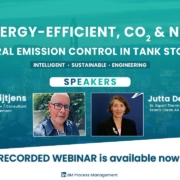
Energy-efficient, CO₂ and NOₓ neutral emission control in tank storage
/in All Webinars, Recorded/by Bart MuijtjensEnergy-efficient, CO₂ and NOₓ neutral emission control in tank storage
The energy transition is reshaping the tank storage industry. While the shift to sustainable fuels accelerates, petroleum products still represent a significant part of global storage and shipping.
Explore how modern, energy-efficient technologies can help tank terminals meet emissions targets, reduce their carbon footprint, and stay ahead of future regulatory demands.
Stricter regulations and climate goals demand smarter emission control—systems that not only reduce VOCs, but do so without adding CO₂ or NOₓ. And what about the ‘hidden’ methane emissions that no one talks about, but will become subject of strict regulation soon?
Meet Our Expert Speakers
Bio:
Bart is a process engineer by trade with 20 years of experience in the process industry. He worked as a process engineer, project manager, and consultant for large engineering companies, equipment manufacturers as well as end users in the field of chemicals, metal processing, oil & gas as well as the food industry.
Emission control has been a common theme in his work from the start. From vapour recovery systems to carbon adsorption, wet gas scrubbers and thermal systems, he has designed and extensively worked with all of them. Bart has extensive knowledge of the engineering side of the systems as well as the legislative framework and also knows the challenges faced when operating all of these systems by first-hand experience.
Bio:
Jutta is a chemical engineer with a long background in emission treatment systems. She worked as a research employee regarding carbon adsorption before moving into the field of thermal treatment systems. For the past 3 decades she has focused on measurement of exhaust air streams, thermal system design, and optimization.
Furthermore, she is a key member in several German norm commissions and closely involved in working groups regarding emission legislation. Combining theoretical knowledge with hands-on experience, she is regarded as one of the key experts in Germany when it comes to the field of efficient thermal emission control systems.
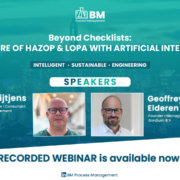
AI Supported HAZOP and LOPA: How to Make Risk Reviews Faster, Clearer and More Consistent
/in All Webinars, Recorded/by Bart MuijtjensAI Supported HAZOP and LOPA: How to Make Risk Reviews Faster, Clearer and More Consistent
Traditional HAZOP and LOPA reviews can take days or even weeks, while operations change every day. In this recorded webinar, BM Process Management and Gordium show how AI and knowledge graph
technology can support experts in making risk reviews faster, more consistent and easier to revalidate, without replacing human judgement.
Webinar Overview
HAZOP methodology has not changed much in sixty years, but our operations and access to data have evolved significantly. Many companies still perform safety reviews infrequently, with long workshop days and static reports that are difficult to revisit when processes change or incidents occur.
In this webinar, Amol from BM Process introduces the need for more dynamic, data driven process safety, together with Bart and Geoffrey. They demonstrate how Gordium supports HAZOP and LOPA studies with AI and knowledge graphs while keeping the expert team fully in control.
Who this webinar is for
- Process safety engineers and HAZOP facilitators
- Process, chemical and operations engineers
- Terminal and plant managers
- Risk management and compliance professionals
- Anyone responsible for process safety improvement
Key Themes Covered
- The shift toward dynamic, AI supported process safety and why traditional tools alone are no longer enough
- Live demonstration of the Gordium platform
- How AI and knowledge graphs support scenario generation and safeguard identification
- How the expert team stays in charge and validates all decisions
- Current features, future roadmap and planned AI copilot tools
- How existing HAZOP studies can be imported, cleaned up and enhanced
- Cost and business impact of improved workshop efficiency and reduced revalidation time
Key Takeaways
- The real challenge is the growing gap between fast operations and slow risk reviews
- Gordium supports scenario consistency and clarity without automating expert judgement
- Clear visuals help bridge communication gaps across multi-disciplinary teams
- Study time can often be reduced by around 50 percent through improved structure and reduced manual work
- Evergreen HAZOP records simplify audits, revalidations and follow up action tracking
- AI supports the experts. It does not replace them
Meet Our Expert Speakers
Bio:
Bart is a process engineer by trade with 20 years of experience in the process industry. He worked as a process engineer, project manager, and consultant for large engineering companies, equipment manufacturers as well as end users in the field of chemicals, metal processing, oil & gas as well as the food industry.
Emission control has been a common theme in his work from the start. From vapour recovery systems to carbon adsorption, wet gas scrubbers and thermal systems, he has designed and extensively worked with all of them. Bart has extensive knowledge of the engineering side of the systems as well as the legislative framework and also knows the challenges faced when operating all of these systems by first-hand experience.
Bio:
With over 25 years of experience in process safety and industrial consulting, Geoffrey leads Gordium’s mission to revolutionize risk management through artificial intelligence. His career spans engineering, chemical production, and international consultancy leadership—bringing a powerful perspective on how digital innovation reshapes safety and efficiency.
About Gordium® : Gordium® redefines process hazard analysis through AI-driven insights. Designed for today’s evolving industrial landscape, its dynamic risk management software transforms static HAZOP, PHA, and LoPA studies into continuous, collaborative processes. By combining structured data models, industry knowledge graphs, and intelligent automation, Gordium® helps teams make faster, clearer, and more consistent safety decisions—anytime, anywhere.
Address
BM Process Management B.V.
Broekstraat 6
5292 ND Gemonde
The Netherlands
Trade Register: 77214579
Quick Links
Get in Touch
E: hello@bmprocess.nl
WhatsApp: +31 6 42173663
Call Us: +31 6 42173663