Consultancy

Consultancy

Sound advice for solid foundations


Expert Consultancy for Process Management & Compliance

At BM Process Management, we provide expert consultancy services to help businesses navigate the complexities of emission regulations, permit applications, and process design.

With deep industry expertise, our consultants advise organisations in achieving compliance, optimising safety, and ensuring operational excellence.

Whether you need strategic advice, regulatory support, or technical expertise in process design, BM Process Management is your trusted partner in achieving compliance, safety, and efficiency.

Let’s optimize your process—together. Contact us today to learn how we can support your business.

  • Emission regulation consultancy We offer expert consultancy on Dutch, Belgian and general European emission regulations, providing reliable advice on permit applications and government dealings.
  • Process safety studies & consultancy From initial reviews on safe process design to Hazop studies, we provide expertise where needed
  • Peer review, second opinion & due diligence With expertise we are at your side reviewing process designs or possible acquisitions
  • Training & education Operations is the key to your success.We assist in developing operational manuals and hands-on training for your staff

Emission regulation consultancy

New European legislation (IED 2.0) and national limits can make permit application or revisions a daunting task.  Our consultants combine legislative insights with hands-on experience in the field, knowing what works. Our expertise will help you succeed. 

The world needs to reduce emissions in order to face the global warming effects. VOCs however have a far greater global warming potential than for example CO2. Another recent challenge is to reduce the deposition of nitrogen in the soil, which requires a strong reduction of reactive components such as NOx.

This leads to the development of stricter emission regulations and legislation in the EU. This change in limit values and the restructuring of legislation requires in-depth insights.

The revised Industrial and Livestock Rearing Emissions Directive (Directive 2010/75/EU or ‘IED 2.0’) as amended by Directive 2024/1785, is the main EU instrument to reduce these emissions into air, water and land, and to prevent waste generation from large industrial installations and intensive livestock farms (pig and poultry).

The latest rules will help promote innovation in new and emerging technologies and foster material efficiency and decarbonisation by encouraging greener practices. This will help large European industries meet the EU’s zero pollution ambition by 2050.

In line with the Zero Pollution ambition of the European Green Deal, the revised Directive will result in less emissions from large industrial installations and pig and poultry farms. This will ensure a healthier environment for people and the planet, whilst spurring innovation, rewarding frontrunners, and providing industry with a level playing field on the EU market and improved investment certainty.

This modernised law will help guide industrial investments necessary for Europe’s transition towards a cleaner, carbon-neutral, more circular and competitive economy.

By 2050, the implementation of the revised Directive is expected to reduce emissions of key air pollutants (PM2.5, SO2, NOX and NMVOC (non-methane volatile organic compounds)) by up to 40% compared to 2020 levels.

From the Industrial Emissions Directive this legislation is translated into national legislation such as the Dutch ‘Activiteitenbesluit’ or the ‘VLAREM II’ in Belgium (Flanders). Combined with the limit values there are the Best Available Technique (BAT) requirements and BAT Reference Documents (BREF) which can contain conclusions on required emission levels.

This is where our expertise comes into play and changes the game for you. We at BM Process are seasoned experts with real hands-on experience. We’re not scared of thinking ‘outside the box’ but we also ensure you get solutions that really work. Not just on paper.

Process safety

Secure the safety of your plant and above all, your employees.

Many industrial facilities, especially those in the chemical, oil and gas and petroleum industries, involve inherent risks in operations due to the processing of material that is hazardous in nature. It is necessary to precisely identify and analyze hazards, operability issues, associated risks and consequences.

Not only for SEVESO III / BRZO companies is process safety a key point of attention, also in other industries this is a growing point of attention. HAZOP and other safety studies start to take place more and more in the food industry for example. Regulatory authorities are becoming more aware of the importance of process safety outside of the traditional high-risk industries.

BM Process Management has over a decade of experience in the field of HAZOP studies as a chairman, scribe and as a subject matter expert during HAZOP meetings. We strive for maximum added value and the highest possible quality in all that we do. This also goes for HAZOP and LOPA studies. Therefore, BM Process is proud to cooperate with Gordium®  in the field of process safety studies. We use the Gordium platform for our safety studies, ensuring you are using the platform of the future.

Revolutionising process hazard analysis: harness the power of AI

Discover Gordium®: Where complex risks are transformed into clear, actionable insights. Revolutionize your HAZOP, PHA, and LoPA processes with dynamic risk management powered by artificial intelligence. Experience the future of safety analysis today.

Experience the refreshing power of innovation with Gordium’s software, cascading like a waterfall over conventional systems. Built from the ground up, free from the constraints of outdated spreadsheet-based models, our software enables you to harness the full force of modern advancements.

While the human mind is unparalleled in imagining unprecedented incidents, there’s a natural caution about using generative AI and Large Language Models (LLMs) in process safety. Should we fully automate HAZOP studies with AI? We believe not. However, ignoring these advanced technologies would also be a lost opportunity.

Gordium® smartly integrates AI to predict relevant scenarios and timely present them to the review team, similar to how Google uses AI to refine search results

How we work

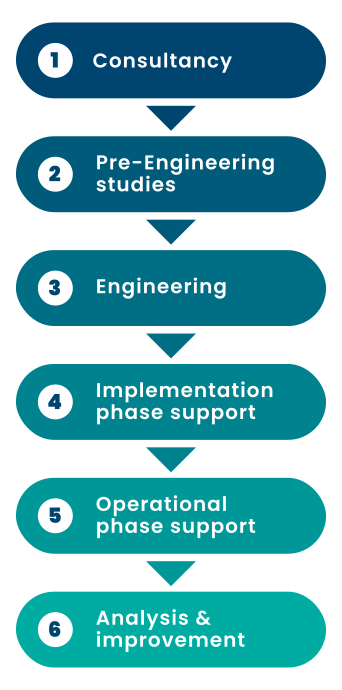
Our support systematically spans all phases in the life cycle of industrial process systems


Peer review & second opinion

Our engineering expertise comes into play when reviewing engineering or consultancy packages from other parties. 

When a project is being engineered, it is common to conduct several stages of design reviews. Do you require specialist input on subjects, or do you just wish a fresh look on the solutions you have in mind? Require expert input as part of a due diligence to see if your investment is a safe one? That is a very good idea! New insights can be useful and so can confirmation of the path chosen. We are happy to assist you in due diligence or peer review requests.

Training program for operational and maintenance staff

Training and education

Operations is the key to your success. No matter how well the project is executed, if the handover to operations is not done well, the end result will suffer.

Operational involvement in projects is of importance to obtain buy-in as well as key information. After the project development and execution, the handover and training are next on the list. Mostly the OEM manuals for equipment are not readable or useable in day to day operations.

We have an operational background and understand the needs. With a hands-on and pragmatic attitude BM Process Management can help you deliver clear results. From involving operational staff in a project to translating OEM manuals into handbooks, topped off with an interesting and fun training.

Commissioning and start-up support

Commissioning a project is the keystone for successful project delivery.

Proper commissioning requires experience, passion, perseverance and pragmatism. Our commissioning engineers assist you with commissioning procedures and plans. Need hands-on support? We’ve got you covered. From leading the commissioning activities to delivering as-built documentation for your installation.


Knowledge base

Welcome to our Knowledge Base, a dedicated platform showcasing our expertise in engineering, emission control, and project execution. Explore our comprehensive content and stay ahead in the ever-evolving industrial landscape.

This month’s feature: emission control in tank storage

In March, the 20th edition of StocExpo is held in Ahoy Rotterdam. Stocexpo is the leading event for safe and sustainable tank storage. We wrote an article detailing our approach to facing the challenges of a changing world in Tank Storage Magazine.

Read it here >>

HAZOP, HAZID and LOPA: Process Safety Studies Explained

BM PROCESS · FAQ

HAZOP, HAZID and LOPA: Process Safety Studies Explained

By the BM Process Management engineering team · Reviewed by our process-safety engineers · Last reviewed: September 2026

HAZOP, short for Hazard and Operability study, is a structured, systematic technique for identifying hazards and operability problems in a process. Together with HAZID and LOPA it forms the core of modern process safety studies.

This page explains what HAZOP means and stands for, how a HAZOP study and review process work, how HAZID and LOPA differ and fit in, who is on a HAZOP team, and how these relate to Hazard Analysis and Critical Control Point (HACCP) thinking. BM Process facilitates these studies as part of its process engineering work.

HAZOP, HAZID and LOPA: Frequently Asked Questions

HAZOP basics and meaning

What is HAZOP and what is a HAZOP?

HAZOP, short for Hazard and Operability study, is a structured, systematic technique for identifying hazards and operability problems in a process. A multidisciplinary team examines the design, usually working from P&IDs, and applies guide words to each part of the process to find ways it could deviate from intent and what the consequences would be. It is one of the most widely used process safety methods in the world.

What does HAZOP stand for and what is its full form?

HAZOP stands for Hazard and Operability study. The name reflects its dual purpose: finding both safety hazards and operability issues that could stop the process running as intended.

What does HAZOP mean?

HAZOP means Hazard and Operability study: a facilitated, team-based examination of a process design that works through it section by section to find credible deviations from the design intent and their consequences.

What is the HAZOP methode or method?

The HAZOP method divides the process into nodes and applies standard guide words to each parameter to prompt the team to consider every credible deviation. It is deliberately systematic so that hazards are found by structured questioning rather than left to chance.

How a HAZOP study and review work

How does a HAZOP study work?

A HAZOP team divides the process into sections or nodes and, for each, applies guide words such as no, more, less, reverse and as well as to parameters like flow, pressure and temperature. For every credible deviation the team identifies causes, consequences, existing safeguards and any actions needed. The structured, node-by-node method is what makes HAZOP so thorough.

What is the HAZOP review process?

A HAZOP review is a facilitated, team-based examination of a defined design, worked through node by node. The facilitator leads the team in applying guide words to each node, the team records causes, consequences, existing safeguards and actions for each credible deviation, and those actions are tracked to closure so the review leads to real improvements rather than just a report.

What is a HAZOP analysis?

A HAZOP analysis is the examination and documentation of each credible deviation found during the study: its cause, its consequence, the safeguards already in place and any further action required. The output is an action list that drives design or procedural changes.

Can AI help with HAZOP and LOPA?

AI tools can assist a HAZOP or LOPA by helping organise nodes, capture records and check consistency, but the study itself relies on the judgement of an experienced multidisciplinary team and a trained facilitator. The value of the study comes from human expertise applied systematically, with any tool used only to support that process.

HAZID, LOPA and the HAZOP team

What is a HAZID study?

HAZID, or Hazard Identification study, is a broader, earlier-stage review that identifies hazards across a project or facility, including external and site-wide risks, before the design is detailed enough for a full HAZOP. It casts a wide net early, so major hazards are recognised while there is still freedom to design them out.

What is the difference between HAZID and HAZOP?

HAZID is broad and early: it identifies the range of hazards, including external ones, at a high level, often in concept or early design. HAZOP is detailed and later: it systematically examines a defined design, usually from P&IDs, for deviations and operability issues. HAZID asks what could threaten this project; HAZOP asks how this specific design could go wrong.

What is LOPA and how does it relate to HAZOP?

LOPA, or Layer of Protection Analysis, is a semi-quantitative method used after HAZOP to judge whether the existing safeguards are enough to reduce a specific risk to a tolerable level. It counts and credits the independent protection layers and shows where additional safeguards may be required. HAZOP finds the scenarios; LOPA tests whether they are adequately protected.

Who is in a HAZOP team?

A HAZOP team is deliberately multidisciplinary, typically including process, mechanical, instrumentation and operations expertise, led by an independent, trained facilitator and supported by a scribe. The mix of perspectives is essential: hazards are often found precisely because people from different disciplines see the same design differently.

When should a HAZOP be carried out?

A HAZOP is normally carried out when the design is mature enough to have firm P&IDs, and it is repeated for significant modifications and periodically over a plant’s life. Earlier hazard reviews such as HAZID cover the concept and early design stages, so hazard management is continuous rather than a single event.

HACCP and critical control points

What is Hazard Analysis and Critical Control Point (HACCP)?

HACCP is a systematic method for managing safety by identifying the significant hazards in a process and the critical control points where they must be controlled, then setting limits and monitoring at those points. It is best known in food safety but shares its underlying logic with process hazard studies: find the hazards, find where they must be controlled, and prove they are.

What is a critical control point and what does it mean?

A critical control point is a step in a process where control is essential to prevent, eliminate or reduce a hazard to an acceptable level. Identifying these points, and setting measurable limits and monitoring for each, is central to HACCP and to risk-based safety management generally.

What is a control point in food and what are critical control points?

In food safety a control point is any step where a hazard can be controlled, and critical control points are the steps where control is essential and must be verified. The same hazard-led logic underlies process safety studies in industry.

What are critical limits in HACCP?

Critical limits are the measurable boundaries at each critical control point that separate safe from unsafe conditions, for example a minimum temperature or a maximum time. Monitoring confirms the process stays within these limits, and defined corrective actions apply if a limit is breached.

How does HACCP relate to HAZOP and process hazard studies?

HACCP and HAZOP share the same core logic: systematically identify hazards and make sure each is controlled where it matters. HACCP centres on critical control points and their limits and is the standard in food safety, while HAZOP centres on deviations from design intent and is the standard in process industries. Both are structured, hazard-led methods aimed at controlling risk rather than reacting after the fact.

Can BM Process facilitate HAZOP and process safety studies?

Yes. BM Process supports process safety through structured studies such as HAZOP, HAZID and LOPA, drawing on multidisciplinary process engineering expertise to identify and control risk. To arrange a study or discuss your requirements, get in touch via https://bmprocess.nl/.

About BM Process Management

Written and reviewed by the BM Process Management engineering team. BM Process Management is an industrial process engineering consultancy based in the Netherlands, facilitating HAZOP, HAZID and LOPA and other process safety studies for industrial clients across Europe. The answers on this page reflect field experience in process safety and risk management.

Vapour Recovery Units (VRU): How They Work, Types and Uses

BM PROCESS · FAQ

Vapour Recovery Units (VRU): How They Work, Types and Uses

By the BM Process Management engineering team · Reviewed by our vapour recovery and emission control engineers · Last reviewed: September 2026

A vapour recovery unit (VRU) is a system that captures hydrocarbon vapours that would otherwise be vented during storage, loading or processing, and returns them to a usable liquid or fuel-gas stream. Instead of losing product and emitting VOCs, a VRU recovers the vapour, cutting both emissions and losses at the same time.

This page explains how a vapour recovery unit works, its main components such as the compressor and vapour recovery tower, the recovery methods and VRU packages available, and where VRUs are used in oil and gas, at tank terminals and on truck and marine loading. BM Process designs and integrates vapour recovery units end to end.

Vapour Recovery Units (VRU): Frequently Asked Questions

VRU basics and how it works

What is a vapour recovery unit (VRU) and what does VRU stand for?

A vapour recovery unit, or VRU, is a system that captures hydrocarbon vapours that would otherwise be vented during storage, loading or processing, and returns them to a usable liquid or fuel-gas stream. VRU stands for vapour recovery unit (also written vapor recovery unit). Instead of losing product and emitting VOCs, a VRU recovers the vapour, cutting both emissions and losses. It is a core building block of any modern vapour emission control system.

How does a vapour recovery unit work?

Vapours displaced from a tank or loading arm are collected and drawn into the unit, where they are typically compressed, then condensed or absorbed so the hydrocarbons return to liquid form while clean gas is released or reused. Common methods are compression and condensation, carbon or lean-oil absorption, and membrane separation. The choice depends on vapour composition, flow rate and recovery target.

What is a vapour recovery unit compressor?

The compressor is the heart of many VRUs. It raises the pressure of the collected vapour so it can be condensed back to liquid or pushed into a fuel-gas or absorption system. Compressor selection, sealing and control are critical to reliable recovery and safe operation, which is why VRU packages are engineered around the vapour’s flow, pressure and composition rather than bought off the shelf.

What is a vapour recovery tower and how does it differ from a VRU?

A vapour recovery tower is a vessel used mainly at oil production sites to capture the low-pressure flash gas that comes off crude before it reaches the storage tanks, stabilising the liquid and routing the recovered vapour on for compression or further recovery. It often works together with a VRU: the tower captures and separates the vapour, and the recovery unit compresses and processes it.

VRU types, methods and packages

What are the main types and methods of vapour recovery system?

The main recovery methods are compression and condensation, in which the vapour is compressed and cooled back to liquid; absorption, in which the vapour is absorbed into a lean oil or passed over activated carbon and then stripped; and membrane separation, which uses selective membranes to concentrate and recover the hydrocarbons. Many real systems combine methods in stages, and the right choice depends on vapour composition, flow and recovery target.

How do you design and size a vapour recovery unit?

Sizing starts with the peak and average vapour flow, the vapour composition and the target recovery or emission limit. From there the recovery method, compressor duty, condensation or absorption stages and controls are engineered together. A well-designed VRU balances recovery efficiency, energy use and reliability rather than simply maximising one of them. BM Process handles this design and integration end to end.

What is a VRU package and what does it include?

A VRU package is a pre-engineered, skid-mounted unit that bundles the compressor, separation or condensation equipment, instrumentation, safety systems and controls into a single deliverable. Packaging shortens installation time and simplifies integration with the wider vapour control system, while still being tailored to the site’s vapour stream.

Can a VRU be used for natural gas as well as liquids?

Yes. VRUs are widely used to recover natural gas and light hydrocarbons that would otherwise be flared or vented, for example casinghead or tank flash gas at production sites. Recovering this gas returns saleable product and cuts methane emissions. The unit is configured for the specific gas composition and pressure.

Who manufactures VRUs, and how big is the vapour recovery units market?

VRUs are supplied by specialist packagers and engineering firms, and the vapour recovery units and services market has grown as emission limits have tightened worldwide, including in oil and gas. Rather than a fixed product, each unit is engineered to the site’s vapour stream, which is why the design and integration matter more than the badge.

Uses in oil, gas, storage and loading

Where are vapour recovery units used in oil and gas?

In oil and gas, VRUs are used on crude and product storage tanks, at truck and rail loading racks, on marine loading jetties and around process equipment where light hydrocarbons flash off. They capture vapours that would otherwise be flared or vented, recovering saleable product and keeping VOC and methane emissions within permit limits.

What is a tank vapour recovery system for storage tanks?

A tank vapour recovery system captures the vapours that storage tanks give off as they are filled or as temperature and pressure change through the day. Instead of venting through the tank’s pressure or vacuum vents, the vapour is collected and sent to a recovery unit. This is a common way to cut both product loss and VOC emissions from tank farms while keeping the tanks within their permit.

What is a vapour recovery system for truck loading?

During truck loading, liquid entering the tanker displaces vapour that must go somewhere. A truck-loading vapour recovery system collects that displaced vapour through the loading arm and routes it to a VRU or vapour destruction unit instead of the atmosphere. It is a standard requirement at compliant loading terminals and protects both air quality and operators.

What is marine vapour recovery?

Marine vapour recovery captures the large volumes of vapour displaced when a vessel is loaded at a jetty. Because marine loading rates are high, these systems are sized for large, variable flows and must meet strict safety and interlocking standards. They combine vapour collection, safety equipment and either recovery or destruction of the collected vapour.

What is a gasoline or fuel vapour recovery system?

A gasoline or fuel vapour recovery system captures the petrol vapours displaced during storage and loading, which are both a valuable product and a significant VOC source. At terminals and depots the displaced vapour is collected and recovered rather than released. The same principle applies from large loading racks down to fuel dispensing, though industrial systems are engineered for far higher flows.

Where is a VOC recovery unit used and what about drum filling?

A VOC recovery unit captures volatile organic compounds from storage, loading, drum filling and process vents so the solvent or hydrocarbon can be reused and emissions cut. It is used across oil and gas, chemicals and any operation that handles volatile liquids. The recovery method is matched to the specific VOCs present.

Recovery vs destruction, control and maintenance

What is the difference between a vapour recovery unit and a vapour destruction unit?

A vapour recovery unit turns captured vapour back into usable product, so it pays back through recovered material. A vapour destruction unit, such as a thermal or catalytic oxidiser, burns the vapour to a harmless state without recovering it. The right choice depends on vapour value, flow rate and site constraints; often the two are combined, with recovery as the primary route and destruction as backup.

What is a vapour control system and how does refinery vapour control fit in?

A vapour control system is the wider set of equipment that manages hydrocarbon vapours across a site, combining vapour collection, recovery units, destruction units where needed, safety devices and controls. A VRU is one component within it, working alongside the wider emission control train. At refineries and terminals, designing the control system as a whole, rather than adding equipment piece by piece, is what keeps a site compliant and efficient.

What does VRU repair and maintenance involve?

VRU maintenance focuses on the parts that do the work under pressure and cyclic duty: the compressor and its seals, valves, instrumentation, and the condensation or absorption media. Reliable recovery depends on keeping these in good order and on the controls being correctly tuned. Because a VRU protects both compliance and product, planned maintenance and prompt repair of any fault are important to avoid unplanned venting.

Does BM Process design and integrate vapour recovery units?

Yes. BM Process designs and integrates vapour recovery units for storage, loading and process applications, handling the sizing, recovery-method selection, packaging and integration with the wider vapour and emission control system. Because we combine process engineering with emission control, the VRU is designed as part of the plant it serves. Outline your requirements at https://bmprocess.nl/.

About BM Process Management

Written and reviewed by the BM Process Management engineering team. BM Process Management is an industrial process and emission control engineering consultancy based in the Netherlands, providing independent engineering, abatement and emission monitoring services for industrial clients across Europe. The answers on this page reflect field experience in designing and integrating vapour recovery units.

CEMS and VOC Monitoring: Continuous Emission Monitoring Explained

BM PROCESS · FAQ

CEMS and VOC Monitoring: Continuous Emission Monitoring Explained

By the BM Process Management engineering team · Reviewed by our emission monitoring and process engineers · Last reviewed: September 2026

A continuous emission monitoring system (CEMS) continuously measures the concentration of pollutants in a stack or vent, records the data, and reports it for regulatory compliance. Alongside VOC monitoring, it is the evidence layer that proves emissions stay within permitted limits at all times.

This page explains what a CEMS is and what it measures, how CEMS works and how CEMS data is handled, what VOC monitoring, detection and instruments involve, and which industries need continuous monitoring. BM Process specifies and integrates emission monitoring as part of its wider emission control work.

CEMS and VOC Monitoring: Frequently Asked Questions

CEMS basics and meaning

What is a continuous emission monitoring system (CEMS)?

A continuous emission monitoring system, or CEMS, continuously measures the concentration of pollutants in a stack or vent, records the data and reports it for regulatory compliance. It typically monitors gases such as NOx, SO2, CO and O2, and sometimes particulates and VOCs. A CEMS is the evidence layer that proves emissions stay within permitted limits at all times, not just during periodic checks.

What does CEMS stand for and what does CEMS mean?

CEMS stands for Continuous Emission Monitoring System. The key word is continuous: rather than taking occasional spot measurements, it monitors emissions in real time so both operators and regulators have an ongoing record of compliance.

What are CEMS and what is a CEMS system?

A CEMS is the complete system of sampling or optical measurement, gas analysers, and data acquisition and handling that continuously measures and reports stack emissions. People refer to it as a CEMS, a CEMS system or an emissions monitoring system; all describe the same real-time compliance monitoring train.

What does CEMS integration mean?

CEMS integration is connecting the monitoring system into the plant so its analysers, sampling and data handling work with the process control and reporting systems. Good integration means the monitoring points, ranges and reporting match the abatement design and the plant’s permit obligations.

How CEMS works and how the data flows

How does a CEMS work and what is the CEMS work process?

A CEMS extracts or optically probes the gas in a stack, measures the pollutants of interest with analysers, and passes the readings to a data acquisition and handling system that validates, averages and reports them. The design depends on the pollutants, the stack conditions and the reporting rules that apply, so a CEMS is engineered to the specific installation rather than bought as a fixed product.

How does CEMS data work and what is CEMS real-time data?

Raw analyser signals are collected by a data acquisition and handling system that applies calibrations, checks validity, calculates the required averages, and produces compliance and exception reports in real time. Well-managed CEMS data gives operators early warning of drift or exceedances and gives regulators a defensible compliance record. The quality of the data handling matters as much as the analysers themselves.

What is CEMS software?

CEMS software is the data acquisition and handling layer that turns raw analyser signals into validated, averaged, reportable data. It applies calibration factors, checks data validity, calculates the averaging periods the permit requires, records everything for audit, and generates compliance and exception reports.

VOC monitoring, detection and instruments

What is VOC monitoring?

VOC monitoring measures volatile organic compounds in emissions or in the working environment, using instruments such as flame ionisation or photoionisation detectors and other VOC analysers. It is used to control fugitive emissions, verify the performance of abatement equipment such as oxidisers and vapour recovery units, and protect worker safety.

What is the difference between VOC detection and VOC monitoring?

VOC detection generally means identifying the presence of VOCs, often for leak detection or safety alarms. VOC monitoring means measuring their concentration continuously or repeatedly to quantify emissions and prove performance. Detection tells you something is there; monitoring tells you how much, over time, which is what compliance and optimisation need.

What VOC instruments, detectors and analysers are used?

Common VOC instruments include flame ionisation detectors (FID) and photoionisation detectors (PID), along with other gas analysers selected for the compounds present. A VOC detector or VOC detection system is used for leak detection and area safety, while continuous VOC analysers quantify emissions for compliance. The right instrument depends on which VOCs are present and whether the aim is detection or measurement.

What VOC monitoring techniques and equipment are available?

Techniques range from continuous stack monitoring to portable survey instruments for leak detection and area monitoring. VOC monitoring equipment is chosen for the compounds present, the concentrations expected and whether the goal is detection, quantification or continuous compliance monitoring.

What VOC control equipment and technologies are available?

VOC control technologies include vapour recovery units that capture and reuse hydrocarbons, thermal and catalytic oxidisers that destroy VOCs, adsorption systems such as activated carbon, and scrubbers, with monitoring used to verify performance. Control and monitoring are usually specified together so the abatement and the evidence that it works are designed as one.

What is VOC analysis?

VOC analysis is the measurement and interpretation of volatile organic compound concentrations in a gas stream or working area, used to quantify emissions, verify abatement performance and support compliance reporting.

Why it matters, who needs it and technology for clean air

Why is real-time emission and VOC monitoring important?

Real-time monitoring catches problems as they happen rather than at the next manual check, so abatement failures, leaks or process upsets can be corrected before they become a compliance breach or a safety issue. It also provides the continuous data needed to demonstrate compliance and to optimise how abatement equipment is run.

Do chemical, manufacturing and oil industry plants need a CEMS?

Many combustion and process sources at chemical, petrochemical, manufacturing and oil industry sites are required to monitor their emissions continuously under environmental permits and directives. CEMS for the chemical industry and for oil and gas is common, and even where it is not strictly mandated a CEMS provides valuable assurance and data. The exact obligation depends on the source and the applicable regulations.

How does CEMS relate to emission control and abatement, and technology for clean air?

Abatement equipment removes or destroys the pollutant; the CEMS proves it worked. They are two halves of the same compliance strategy and are best specified together, so the monitoring points, ranges and reporting match the abatement design and the plant’s permit obligations from the outset. See how this fits into the wider emission control picture for more.

What CEMS services does BM Process provide?

BM Process supports emission monitoring as part of its wider emission control and process engineering work, helping match monitoring to the pollutants, permit obligations and abatement design of the site. To discuss a continuous emission monitoring system for your plant, get in touch via https://bmprocess.nl/.

About BM Process Management

Written and reviewed by the BM Process Management engineering team. BM Process Management is an industrial process and emission control engineering consultancy based in the Netherlands, specifying and integrating continuous emission monitoring and VOC monitoring for industrial clients across Europe. The answers on this page reflect field experience in emission monitoring and abatement.


Trusted by industry leaders

Our client portfolio


Our projects

Explore our proven track record of delivering innovative and efficient solutions in process engineering and consultancy. From optimizing complex systems to implementing cutting-edge emission control technologies, our projects showcase our commitment to excellence, sustainability, and client success.